
Fermented foods have a habit of appearing in nutritional discourse at two opposite registers: either as the subject of energetic enthusiasm bordering on advocacy, or as a niche acquired taste of limited practical relevance to everyday cooking. Neither register serves the ingredient particularly well. The more useful frame is the one that emerges from simply watching how people eat across a period of months — and noting, with some care, what changes when fermented staples are woven into the weekly meal structure.
Fermentation as a Culinary Constant
Fermentation is one of the oldest documented food preservation and transformation processes in any culinary tradition. Yogurt, aged cheese, sourdough bread, miso, kimchi, sauerkraut, kefir — across geographies and centuries, fermented foods have appeared as ordinary components of everyday eating, not as specialised additions to a particular programme. The current interest in the gut and its relationship to broader wellbeing has lent these ingredients a renewed visibility, but they pre-date that conversation by millennia.
The published research on fermented foods and gut ecology is substantial and growing. Without citing individual studies — which are subject to ongoing development and revision — the general direction of the literature is consistent: regular inclusion of fermented foods appears, across multiple replicated findings, to correlate positively with measures of gut microbial diversity. Microbial diversity, in turn, is associated in the same body of literature with broader markers of nutritional function and general wellbeing. These associations are documented, not definitive, and the field is careful to distinguish correlation from established causation.
The practical question — what this means for a household navigating an ordinary week of meals — is less well-served by the existing literature. This piece attempts to address that gap from an observational rather than an experimental perspective.
What Changes When Fermented Foods Enter the Weekly Rotation
The observations below are drawn from an informal record kept across two household contexts over a period of eight weeks, during which fermented staples were deliberately introduced into the weekly meal structure at a modest frequency — roughly three to four servings per week, spread across different meal occasions. The specific foods used were commercially available and widely stocked: live-culture yogurt, unpasteurised miso, traditionally fermented sauerkraut, and a kefir-style fermented drink.
The first documented change was not physiological but compositional: the inclusion of fermented staples prompted more deliberate thinking about what else was on the plate. Miso, for instance, used as a base for soups and dressings, naturally directed attention toward the vegetable accompaniments. Sauerkraut as a side shifted the composition of simple weekday meals — a sausage dinner with sauerkraut has a different nutritional profile than the same dinner without it, with the addition of fermented vegetables introducing fibre, acidity, and variety without requiring the preparation of an additional dish.
The second documented change was in what might be called the digestive cadence of the eating day. Both households reported — in their own notes, without prompting — a perceptible shift in how settled the hours following meals felt. This is a subjective observation and is recorded as such. It is consistent with what the published literature describes in relation to fermented food intake and digestive function, but the observation period is too short and the sample too small for any stronger characterisation.
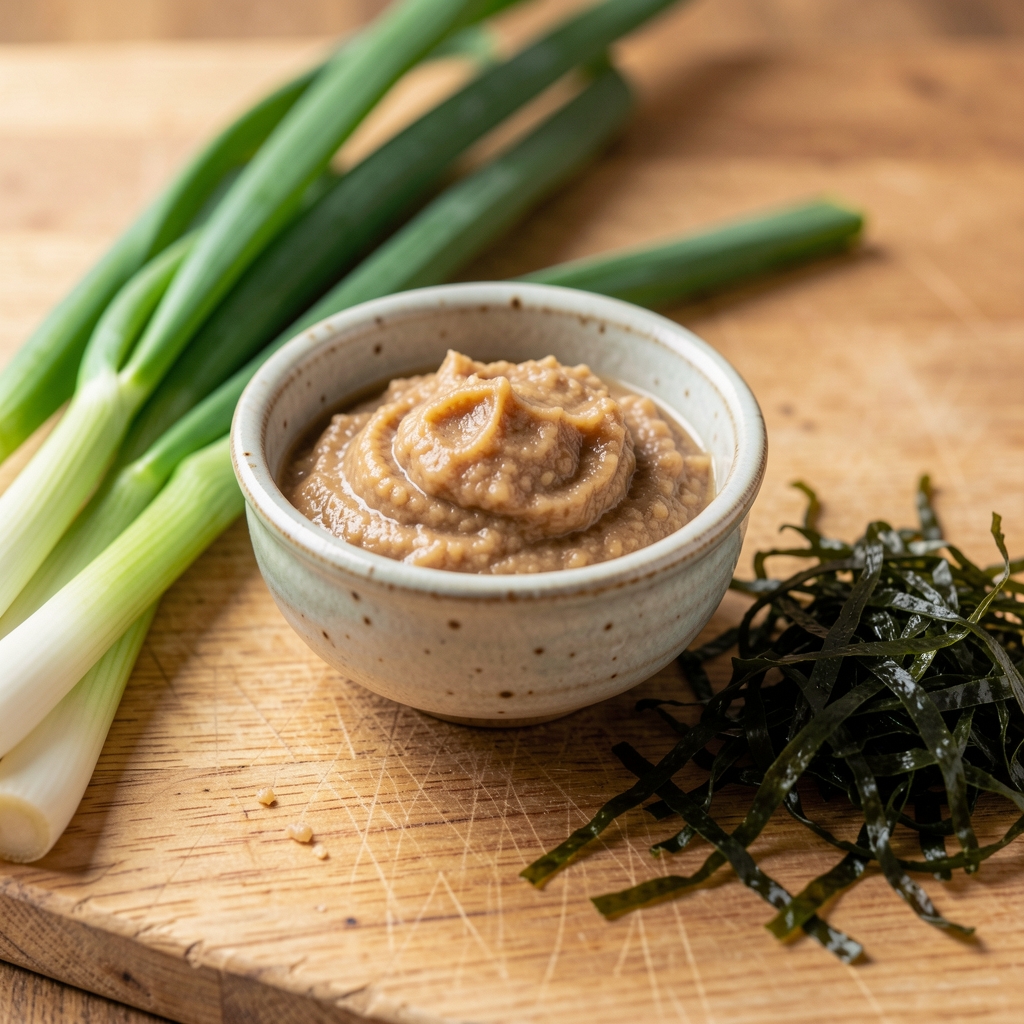
"The most consistent finding from the observation period: fermented foods changed what surrounded them on the plate more than they changed anything else."
— Field notes, Notebook 02, February 2026
Starting Points for the Ordinary Kitchen
The barrier to including fermented foods in everyday cooking is consistently overstated. It does not require a programme of home fermentation, a specialist food shop, or a restructured approach to meal planning. The fermented staples most relevant to the observational notes above are widely available, moderately priced, and easily incorporated into existing meal patterns with minimal adjustment.
Live-culture yogurt — distinct from the pasteurised varieties that constitute the majority of supermarket stock — serves as a versatile base for breakfast, dressings, and accompaniments. Reading the label for the presence of named live cultures is the relevant distinction; the cost differential from standard yogurt is modest. Miso paste, kept refrigerated after opening, has a long shelf life and adds complexity to soups, marinades, and dressings with a small quantity — a teaspoon to a tablespoon is sufficient for most applications.
Traditionally fermented sauerkraut — sold refrigerated in the chilled section rather than on ambient shelves, which distinguishes the live-fermented product from the pasteurised alternative — works as an accompaniment to a range of main dishes, providing textural contrast and the acidity that the gut-friendly literature associates with beneficial activity. For households accustomed to the sharper flavour profile, pickled cabbage in its various regional variations is an accessible equivalent.
Fitting Fermented Staples into Weekly Meal Planning
The households observed during the eight-week period used a simple integration approach: one fermented element was designated as a standing component of the weekly shop — the same product each week to begin with, introducing variety only after the habit of purchasing and using it was established. This modest structural change produced, in the observational notes, the most consistent incorporation pattern. The fermented element was present because it had been purchased, not because a specific decision was made at each meal about whether to include it.
A secondary integration approach emerged naturally from the meal planning context: fermented condiments and accompaniments — miso, live-culture dairy, sauerkraut — do not require cooking or significant preparation, which means they can be introduced as finishing elements to cooked dishes with minimal friction. A bowl of plain rice with miso-dressed vegetables and a spoonful of live yogurt is a complete and varied meal that requires almost no culinary skill. The simplicity of this integration pathway was a consistent feature of the most successful periods of incorporation in the observational notes.
The eight-week observation period was not long enough to draw conclusions about sustained habit formation. What it documented was an entry-level pattern of integration — the conditions under which fermented foods appeared most readily in everyday meal structures — that suggests low-threshold starting points for households interested in shifting in this direction without a significant overhaul of existing eating practices.
- 01 Fermented foods change meal composition through association — their flavour profiles naturally direct attention toward complementary vegetables, grains, and proteins.
- 02 The distinction between live-fermented and pasteurised versions of the same product matters — refrigerated products labelled with named live cultures are the relevant category.
- 03 Integration is most consistent when a single fermented staple becomes a standing shopping-list item, before variety is introduced — habit of purchase precedes habit of use.
- 04 Fermented condiments and accompaniments require no cooking — they are finishing elements, making their inclusion structurally simple even in low-effort meal contexts.
The Case for Quiet Consistency
The argument for fermented foods in everyday cooking is most persuasive when it is made quietly — not as a major dietary shift, not as a corrective programme, but as a low-cost structural adjustment to the weekly meal rotation that introduces variety, supports digestive function as documented in the published literature, and changes the compositional character of meals without requiring significant effort or expense.
The observational notes from this piece do not constitute a recommendation in the formal sense, and they should not be read as one. They are a record of what was noted over a defined period in two household contexts. The patterns are consistent enough to be worth sharing; they are not robust enough to be regarded as guidance. The appropriate next step for any reader with specific dietary considerations is a conversation with a qualified nutrition professional.
We recommend speaking with a qualified wellness or nutrition professional before introducing any new habit, food choice, or physical routine, particularly if you have specific dietary requirements or are taking structured supplements.

Tobias Renshaw is a food writer and contributing author at Darnev Letters, with a background in culinary journalism and an ongoing interest in the practical intersection of food culture and nutrition.
More from this author →